

Identify the AI Tools and Agents You Don’t Know You Have with DTEX AI Risk Management

MIN
AI didn’t just enter the enterprise. It crossed the trust boundary.
It’s now a regular part of how work gets done. And in many cases, it’s doing that work on its own. Today’s AI tools have access to your data, your systems, and your workflows. They read, write, decide, and act. And in many cases, they do so autonomously.
This phase of AI adoption requires a new approach to security. Most organizations can see AI activity. Few can determine whether that activity actually creates risk. Security teams were never designed to monitor digital insiders that operate with runtime autonomy, blur identity boundaries, and follow unique behavioral patterns. But that’s exactly what AI introduces. That is why DTEX is introducing AI Risk Management (AIRM).
AIRM combines behavioral and AI risk intelligence with Agentic Defenders to help organizations understand, investigate, and control risk across the human and AI-driven estate.
AI Risk Management is built for exactly how AI risk works
As AI becomes embedded in workflows and autonomous agents take on more responsibility, the speed and scale of activity increasingly outpace what security teams can investigate manually. AI risk doesn’t occur in a single prompt. It spans browsers, desktop apps, APIs, copilots, and autonomous agents. That’s why AI Risk Management is built on a behavior-backed intelligence engine, created over two decades of behavioral research and insider investigations, with agent defenders that help teams prioritize risk. It captures how both people and AI interact with data and systems over time, not just at a single point in time. This approach enables something most tools struggle to do well: differentiate normal activity from early signs of risk by understanding context and intent.
Alert visibility alone isn’t enough. Context is everything.
To make AI risk actionable, DTEX combines unified telemetry, prompt and data lineage, continuous risk intelligence, and proven investigation workflows. This foundation grounds frontier AI models in real-world behavioral context, enabling them to analyze activity, identify emerging risk patterns, and help security teams understand what happened, why it happened, and where risk is escalating across AI, human, and data-driven activity. It is designed around this reality:
Ingest signals:
- AI activity across browser, desktop, APIs, copilots, and agents
- User behavior (who is doing what, where, and how)
- Data movement (uploads, downloads, prompts, generated outputs)
- Identity context (corporate vs. personal accounts, role, Computer Use Agent process lineage)
Correlate observations and indicators:
- Human actions with AI interactions
- Prompt intent with downstream actions
- Data exposure with user behavior patterns over time
- AI-driven workflows across multiple steps (not just a single event)
- Autonomous agent behavior with the human, system, and data context around it
Agent-oriented output:
- Risk-scored workflows, not isolated alerts
- Prioritized incidents based on intent and context
- Behavioral attribution across human, AI, and combined activity, scored on the weight of evidence, not a single indicator
- Lineage of actions to explain how risk unfolded
- AI intelligence that expedites decisions with the appropriate response
This is what enables AI Risk Management to answer the question most tools can’t: “Did this AI activity actually create risk, and do we need to act?”
AI Risk Intelligence is the novel foundation
As a unique, multi-framework system built on insider risk methodologies and AI-specific risk models, DTEX AI Risk Intelligence functions as the differentiator, informing anomaly detection in both human and AI-driven activity. It leverages AI-specific risk models that differentiate intentional from unintentional AI actions and delineates a rogue AI agent from a malicious employee.
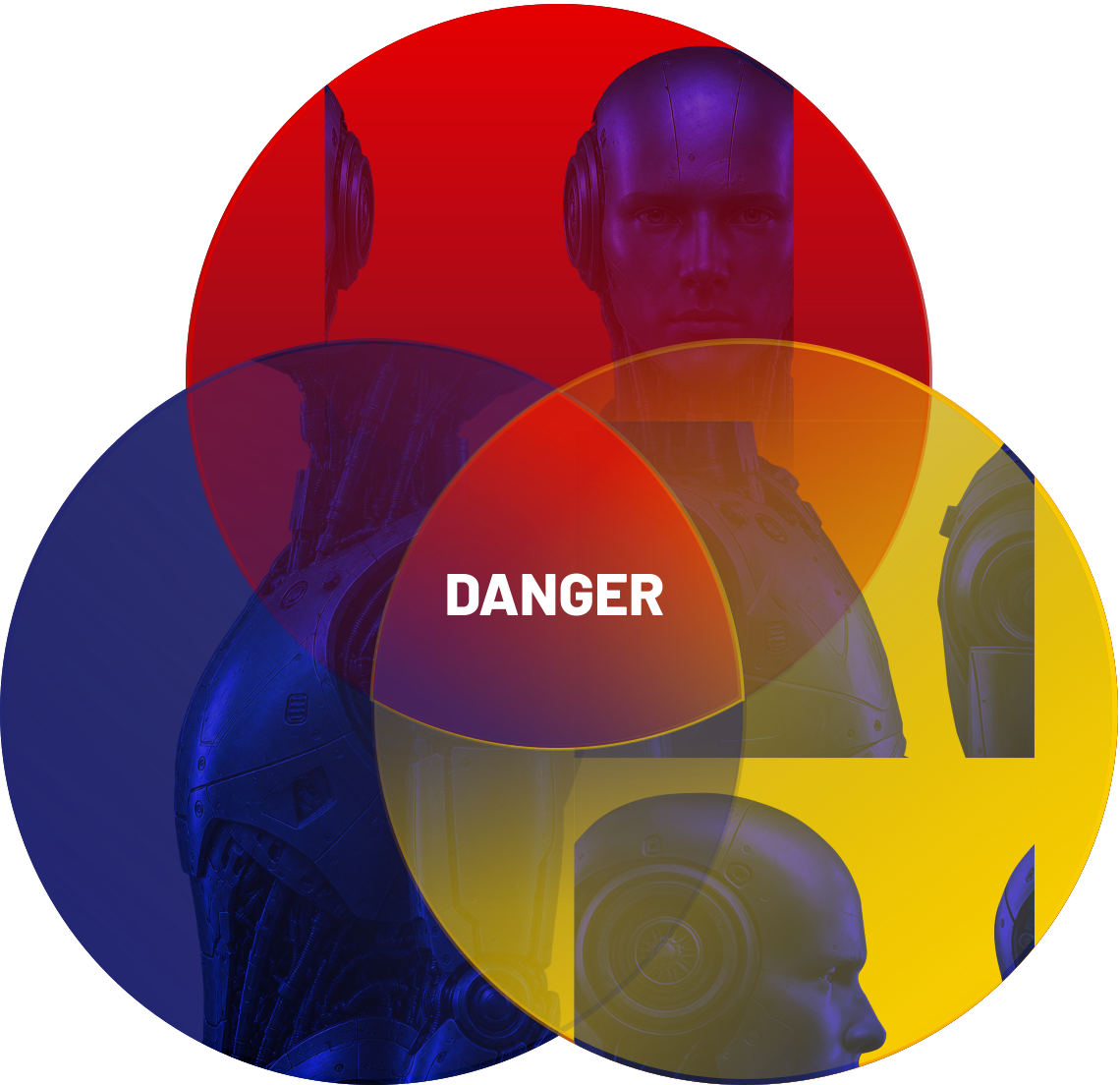
As AI agents access data, generate outputs, and increasingly perform multi-step actions across workflows and systems, they become digital actors operating inside trusted environments. The potential risk of a given AI agent expands exponentially when it has access to sensitive data, can communicate externally, and is exposed to untrusted content. When an AI system or workflow has all three, it forms the lethal trifecta, creating a high-risk scenario.
Access to sensitive data
- Security keys
- Customer data
- Sensitive audit logs
- Sensitive IP
Ability to externally communicate
- Personal webmail
- Corporate email
- HTTP / web access
- Payment access
Exposure to untrusted content
- Public downloads
- GitHub content
- Untrusted MCP data
- Untrusted web pages
Meet the DTEX Agentic Defenders
Powering AI Risk Management analysis, DTEX Agentic Defenders continuously hunt, investigate, and summarize related, complex signals in simple language, across user and AI-driven activity. They help security teams uncover risk without manually piecing together activity across users, agents, data and workflows. This enables higher fidelity detection, reduced noise, and a step-change in the effectiveness of risk operations.
Built on years of running and refining insider investigations, Triage Guardian Agent, Threat Hunter Agent, and AI Risk Assistant, apply proven investigative methodologies at the speed and scale that AI demands. Their conclusions are grounded in high-fidelity metadata, a continuous audit trail, and an expanded activity window rather than human interpretation. Our advantage is a proprietary enterprise context layer that makes DTEX frontier models more reliable for real security operations.
The result is faster investigations, higher-confidence decisions, and a more scalable approach to managing risk across the human and AI enterprise.
How the Agentic Defenders drive AI Risk Management capabilities
In terms of capabilities, instead of monitoring isolated events, AI Risk Management organizes risk into three connected areas, each representing part of a broader workflow, and visualizes the AI factors influencing risk scores.
1. AI utilization: understanding what’s happening with AI overall
Most tools stop at visibility and what AI tools are in use. DTEX AI Risk Management goes further, linking usage + intent + outcome. It delivers deep visibility across GenAI tools like ChatGPT, Gemini, Copilot, and Grok, developer tools and embedded copilots, and file uploads, downloads, and generated outputs. AIRM visualizes AI factors influencing risk scores and gives insights and take aways on AI trends and new AI activity.
But it doesn’t stop at activity. It analyzes:
- Prompt topics and inferred intent
- Data movement and exposure
- Differences between corporate vs. personal accounts
AI utilization use case: sensitive prompt → downstream exposure
What happened | |
| User activity |
|
DTEX AI Risk Management | |
| DTEX AIRM |
|
The result | |
| A traditional tool sees prompt activity. AI Risk Management sees a workflow. | The result? DTEX AIRM flags this as a policy-relevant exposure workflow, not just a prompt event, prioritized based on sensitivity and context. So instead of just seeing usage, teams understand risk in context. |
This is the shift security teams need to make. Move from monitoring AI activity to managing AI risk like an insider, based on behavior, intent, and exposure.
2. Shadow AI discovery: finding risk before it scales
Shadow AI is evolving faster than shadow IT ever did. New tools and embedded copilots show up overnight. Employees experiment constantly. And sensitive data can be exposed before policies even exist.
DTEX AI Risk Management surfaces unsanctioned AI tools, unauthorized embedded copilots, and unapproved workflows (browser, IDE, or application based) through behavioral discovery rather than signatures alone. Because it focuses on how tools behave, not just what they’re called, it catches usage that evades name- or signature-based controls.
Shadow AI use case: unsanctioned tool + sensitive workflow
What happened | |
| A developer uses an unapproved AI coding assistant via a personal account. |
|
DTEX AI Risk Management | |
| DTEX AIRM correlates |
|
The result | |
| The result? | This is surfaced as a high-risk shadow AI workflow, not just “new tool detected.” |
This isn’t just about inventory. It’s about uncovering risk before it becomes a problem. Because with AI, exposure isn’t gradual. It’s immediate and often irreversible.
3. AI agent oversight: managing autonomous behavior
Here’s where things get really interesting. AI agents introduce something new: multi-step, autonomous execution. Agents don’t just assist. They query knowledge bases, call APIs, generate and send content, and execute multi-step workflows.
They operate as privileged digital actors. That makes AI agent security a core part of AI risk management. If an agent can access data, make decisions, or act autonomously, it needs to be observable, attributable, and managed in context.
DTEX AI Risk Management provides:
- Observability into agent behavior and interactions
- Prompt lineage, including agent instructions and detailed reasoning on how decisions are made
- Added behavioral and data-movement signals filling in where prompt content isn’t directly accessible
- Behavioral attribution that distinguishes likely human-driven activity from autonomous execution
AI agent use case: autonomous agent executing a risky chain
What happened | |
| An AI agent |
|
DTEX AI Risk Management | |
| DTEX AIRM provides |
|
The result | |
| The result? | The entire sequence is identified as one explainable risk event, enabling confident investigation and response. |
This level of transparency is critical as organizations move up the “automation pyramid,” where actions become less visible and harder to explain. You cannot secure AI agents by inspecting prompts alone. You must understand the full chain of behavior, from initiation to outcome.
Why DTEX AI Risk Management is different
Most AI security tools focus on prompts, APIs, and model-level controls. But risk doesn’t happen at a single point in time. It unfolds across human decisions, AI-generated outputs, and multi-step workflows.
As experts in Computer Use AI with deep visibility and advanced behavioral analysis, DTEX analyzes actions across users, agents, and workflows, capturing what agents were asked to do and the full lineage of what actually occurred across systems, not just AI content. AIRM connects these into one continuous picture of risk, allowing teams to distinguish normal, safe activity from real exposure while dramatically reducing alert noise. Instead of chasing activity, security teams can focus on the behaviors and workflows that matter.
This is what makes the DTEX approach different: it treats AI risk as a behavioral, workflow-level insider risk challenge, not just a prompt security, DLP, or application control problem.
Securing the human and AI enterprise
The future of security isn’t about protecting systems in isolation. It’s about managing risk across all trusted actors, human and machine. Organizations don’t need more visibility into prompts. They need clarity across workflows.
DTEX AI Risk Management delivers that by:
- Connecting human behavior and AI activity
- Providing context, lineage, and attribution
- Turning raw activity into actionable risk intelligence
To embrace the next phase of AI adoption without sacrificing security, organizations must:
- Understand intent, not just activity
- Maintain oversight of autonomous agents
- Prioritize risk across humans, AI, data, and workflows
Because AI isn’t just another technology layer. It’s a new kind of insider.
Ready to see DTEX AI Risk Management in action?
FAQ: managing AI insider risk
AI insider risk is the exposure created when AI tools, copilots, or autonomous agents access data, make decisions, or take action inside trusted enterprise environments. It includes sanctioned AI use, shadow AI, data leakage, risky workflows, and unclear attribution between human and machine activity.
Start by identifying where AI is used, what data it touches, who initiates activity, and what actions follow. Effective AI risk management requires behavioral intelligence, workflow-level visibility, shadow AI discovery, and AI agent security controls that connect usage, intent, access, and outcome.
Shadow AI creates risk because employees can use unsanctioned tools, personal accounts, or embedded copilots before security teams have visibility or policies in place. Sensitive data may be uploaded, transformed, or exposed externally without detection, making context-based discovery essential.
Behavioral intelligence helps distinguish normal AI use from risky activity by analyzing patterns over time. It connects human actions, AI interactions, data movement, identity context, and autonomous behavior so teams can prioritize real exposure instead of chasing isolated prompts or alerts.
Topics
Subscribe today to stay informed and get regular updates from DTEX
