

Foreign Interference
Protect Intellectual Property from State-Sponsored Insider Threats
Nation-state actors increasingly exploit trusted access, recruiting or placing insiders to steal intellectual property and sensitive data on behalf of foreign governments. Because malicious activity can look like legitimate user behavior, traditional security tools often miss the warning signs. Behavioral intelligence surfaces the risk before exposure.
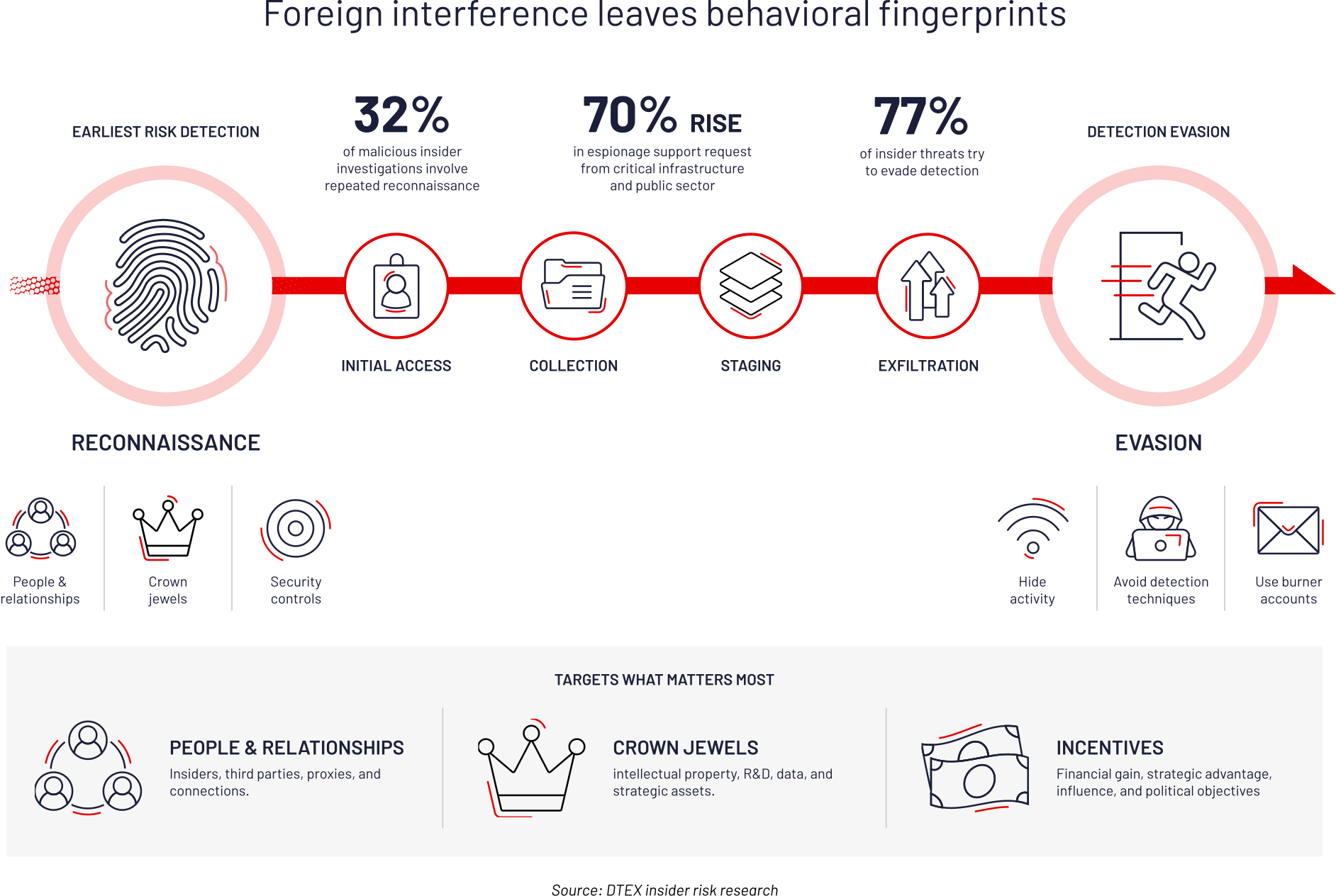
Foreign interference infiltrates the enterprise in multiple ways
Nation-state actors can exploit applicants, employees, contractors, external recruiters, and compromised insiders to gain trusted access to sensitive data and intellectual property. The challenge is connecting signals across identity, access, user behavior, and data activity early enough to recognize a coordinated threat.
DPRK IT worker scheme
North Korean operatives are landing remote jobs at Western companies using stolen and AI-generated identities. Every paycheck funds the regime. Every login is a foothold inside code, customer data, and IP.
Chinese talent recruitment programs
Researchers and engineers are accepting undisclosed funding, roles, or affiliations tied to the Chinese state. The result: sensitive IP and strategic research quietly transferred offshore, eroding competitive advantage and national security.
Recruitment and coercion of trusted employees
Foreign intelligent services are targeting employees through channels like LinkedIn, offering cash or applying pressure on family overseas. Trusted employees turn into sources, leaking sensitive data through legitimate access that traditional perimeter security cannot detect.
Critical infrastructure pre-positioning
Nation-state actors are gaining persistent access to energy, water, and telecommunications, and other critical infrastructure, often using valid credentials to blend in and wait.The objective may not be immediate disruption, but to establish access that can be activated during a future conflict or crisis.
AI-assisted deception and intrusion
Adversaries are using deepfakes and AI-generated personas to pass interviews and scale social engineering at speed. Enterprises are onboarding fake employees, approving fraudulent transactions and losing IP to insiders who never existed.
See how a nation-state planted an insider to steal sensitive AI research
Watch how DTEX uncovered a foreign national planted to steal AI research and delivered the forensic evidence to support prosecution.
Detect the behavior behind foreign interference
Connect behavioral signals, sensitive data activity, and investigative context so teams can identify and prioritize risk without treating every anomaly as malicious.

Early warning behavioral indicators
Surface patterns of reconnaissance, unusual access, data aggregation, concealment, and detection evasion. Automatic baselining, anomaly detection, and risk scoring help identify meaningful deviations before sensitive data is exposed.

Proactive insider threat hunting
Hunt one of the richest insider risk datasets using open-source query language. Surface suspicious activity that may warrant investigation into DPRK IT workers, embedded operatives or others acting for foreign states.

IP theft and data loss visibility
Detect aggregation, obfuscation, staging, and other behaviors that can precede exfiltration. Data lineage reveals who accessed, altered, moved, or shared sensitive IP, R&D, source code, and other high-value data.

MITRE ATT&CK-aligned investigation
Use deep endpoint telemetry mapped to MITRE ATT&CK to uncover signs of infiltration, lateral movement, privilege escalation, credential misuse, and detection-evasion tradecraft.

Prosecution-ready digital forensics
Continuously capture relevant user and system activity to create a defensible forensic record that supports incident response, legal action, and prosecution of nation-state-backed insider threats.

DTEX i³ Insider Intelligence and Investigations
Extend your team with specialist counter-insider threat expertise, adversary intelligence, proactive threat hunting, hands-on investigations, and guidance to help anticipate and disrupt foreign interference.
Turn emerging threat intelligence into action
Foreign interference changes as adversaries adapt their identities, access methods, and tradecraft. DTEX i3 research gives security and insider risk teams practical indicators, investigative context, and mitigation considerations grounded in observed threat activity.
 i³ Threat Advisory Identifying North Korean IT Workers
North Korea’s IT worker scheme has stolen billions and infiltrated the Fortune 500. This advisory reveals the evolving evasion techniques and indicators to spot operatives early.
 i³ Threat Advisory Insider Sabotage: When Trusted Hires Turn Rogue
The most dangerous insider can be the one you trusted most. This advisory unpacks real sabotage cases — from logic bombs to post-termination attacks — and the signals that betray them.
 i³ Threat Advisory Detecting Nation-state Cyber Espionage
Critical infrastructure is under siege from nation-state espionage. This advisory unpacks lessons from Salt Typhoon and Volt Typhoon, and the insider risk strategies that surface abnormal privileged behavior before damage.
 i³ Threat Advisory Detecting Claude Cowork Insider Threat Activity
DTEX i³ simulations show Anthropic’s Claude Cowork can exfiltrate data through trusted user sessions in 10–30 minutes. This advisory unpacks the indicators, prompt analysis and detections security teams need.
Watch DTEX help 60 Minutes expose a DPRK operative in an undercover sting

FAQs on nation-state insider threat
A nation-state insider threat is when a foreign government uses a trusted insider (an employee, contractor, applicant or embedded operative) to steal intellectual property, disrupt operations, conduct espionage or advance strategic objectives. Examples include DPRK IT worker schemes, China’s talent recruitment programs, and other entities operating on behalf of state interests.
The DPRK IT worker scheme is a North Korean state-run operation that places skilled IT workers, using stolen or synthetic identities, into remote roles at Western enterprises. Revenue funds weapons and missile programs in violation of sanctions. DTEX i³ has published behavioral indicators and email IOCs to help detect them.
Warning signs of foreign interference include repeated reconnaissance into people, crown jewels or security controls; anomalous access to sensitive R&D or IP; detection-evasion tactics like hiding internet connections or using burner accounts; unusual off-hours activity; and undisclosed external affiliations. DTEX detects these behavioral indicators before exfiltration.
Most foreign interference goes undetected for months or years because operatives use legitimate credentials and blend into normal workflows. Indicators include unexplained data movement, undisclosed external affiliations, repeated reconnaissance on crown jewels and anomalous system access. Behavioral intelligence exposes what perimeter and identity tools can’t.
DTEX combines behavioral intelligence from its platform with elite counterintelligence investigators from DTEX i³. Together they detect early-stage signals across the insider kill chain (from reconnaissance to detection evasion to exfiltration) and deliver the forensic evidence needed to support internal action, disruption and prosecution.
The latest foreign interference resources

The hardest cases leave fingerprints. DTEX finds them first.
From reconnaissance to prosecution. See how DTEX changes the outcome.