



Shadow AI
Shadow AI is creating invisible risk.
Unsanctioned AI tools, embedded copilots, and autonomous workflows are changing how sensitive data moves through the enterprise. Without visibility into human and AI activity, organizations struggle to identify emerging risk before it becomes exposure.
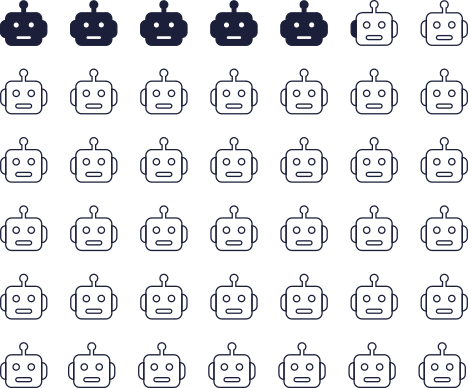
87%
have not formally adopted AI into their business strategies.
AI adoption is accelerating across the workforce, often faster than organizations can establish visibility, oversight, and risk management practices.
73%
worry that unauthorized AI use is creating invisible data loss pathways.
Shadow AI is making it harder for security teams to understand where sensitive data is being accessed, shared, and exposed.
19%
classify AI agents as equivalent to human insiders.
Organizations increasingly recognize the risk posed by autonomous agents, yet few apply the same oversight used for privileged employees.
*Data from the 2026 Ponemon Report
AI risk is fragmented across users, data, and AI systems
Knowing which AI tools are being used is only part of the challenge. Understanding how they’re being used and where they create risk is what matters.
Unsanctioned AI adoption
New AI applications, copilots, and embedded AI features enter your environment faster than security teams can evaluate, govern, or monitor them.
Hidden AI activity
AI interactions move through encrypted traffic, desktop applications, browser extensions, and off-network activity where traditional security tools have limited visibility.
Behavioral risk at scale
As AI usage accelerates, security teams struggle to distinguish low-risk experimentation from negligent, compromised, or high-risk user behavior.
Shadow AI inside trusted applications
Shadow AI exists beyond unsanctioned tools, and embedded AI features inside trusted SaaS applications can expose sensitive data through everyday employee workflows.
Lack of behavioral context
Traditional security tools can detect AI activity, but they cannot determine user intent, behavioral patterns, or whether activity represents meaningful organizational risk.
See how DTEX identifies and deters AI misuse and abuse
Watch a real-world example of how DTEX surfaces agentic activity, attributes every action to its source, and stops autonomous data movement before it leaves the enterprise.
Go beyond AI discovery with behavioral AI risk detection

Continuous AI activity discovery
Dynamically build your sanctioned AI list through statistical comparison against observed usage, auto-classifying new tools the moment they appear.

Prompt + intent behavioral visibility
Inspect AI usage at the endpoint, on or off the network, capturing both prompt content and intent that network appliances can’t see.

Pre-encryption visibility
Capture AI prompts, uploads, and sensitive interactions before encryption or transmission to external AI platforms, enabling visibility into data exposure traditional network controls may miss.

Unified SaaS + endpoint coverage
Get combined visibility of endpoint and native SaaS API integrations across Copilot, ChatGPT, Gemini, and the long tail, closing both halves of the gap.

Risk-based prioritization
Identify high-risk AI behavior based on user activity, sensitive data interaction, and behavioral indicators, not just AI application usage.

AI-powered investigations
Accelerate investigations with agentic-driven analysis, behavioral context, and correlated AI activity across users, prompts, and sensitive data.
See shadow AI across the enterprise in real time
DTEX AI Risk Management continuously identifies unsanctioned AI tools, embedded copilots, risky AI interactions, and emerging behavioral risk across browsers, desktop applications, and autonomous workflows.
The difference between detecting AI usage and understanding AI risk
Most traditional security tools were not designed to inspect AI interactions, prompts, or behavioral context.
| Coverage needed for shadow AI discovery | What traditional tools offer | DTEX AI Risk Management |
|---|---|---|
| Dynamic AI tool inventory | Static AI category lists miss local models, AI browsers, and embedded SaaS features | Continuously discovers and auto-classifies unsanctioned AI tools across browsers, endpoints, IDEs, and embedded SaaS |
| AI tool and prompt risk classification | Regex and pattern matching see content, not intent, and domain matching classifies by destination only | Classifies both the AI tool and the intent of the prompt to identify risky and malicious behavior |
| Endpoint TLS inspection for AI | Network proxies decrypt at the gateway only, breaking down on personal devices and on- or off-network connections | Inspects AI traffic at the endpoint before encryption, on- or off-network, and sensitive session content analyzed locally |
| SaaS API integration | Some tools see sanctioned SaaS apps but not the embedded AI features inside it | Natively integrates SaaS APIs across GenAI tools already in use for expanded endpoint visibility |
The next challenge: monitoring autonomous AI agents
As organizations adopt agentic AI systems and autonomous workflows, security teams need visibility into how AI agents access data, interact with systems, and introduce operational risk. Explore how DTEX helps organizations monitor and oversee AI agents at scale.
FAQs about shadow AI
Shadow AI is the use of AI tools, models, or applications by employees without the knowledge, approval, or oversight of IT and security teams. This includes unsanctioned use of public LLMs like ChatGPT, Gemini, or Claude, AI-enabled browser extensions, embedded AI features in SaaS products, and custom-built models or agents created outside official channels. Because these tools operate outside surveillance frameworks, they create blind spots around data exposure, compliance, and risk.
Shadow AI is a risk because it can expose sensitive data, violate compliance requirements, and introduce unvetted models into critical workflows. Employees often paste confidential information (source code, customer records, financial data, or PII) into public AI tools, where it may be retained, used for training, or leaked. Shadow AI also bypasses standard controls like DLP, access management, and audit logging, making it impossible to assess regulatory exposure under frameworks such as GDPR, HIPAA, the EU AI Act, and SOC 2.
Shadow AI is discovered through continuous monitoring of network traffic, SaaS activity, browser usage, and identity signals to identify unsanctioned AI tools and AI-enabled features in use across the organization. Effective shadow AI discovery combines network telemetry, endpoint visibility, SSO and OAuth logs, and an up-to-date catalog of known AI vendors and embedded AI capabilities. The output is a real-time inventory of which AI tools are being used, by whom, how often, and what data is flowing into them.
Shadow AI is a subset of shadow IT focused specifically on unauthorized AI tools, models, and AI-powered features, but it carries distinct risks that traditional shadow IT discovery doesn’t address. Standard shadow IT scanners catalog SaaS apps but often miss AI features embedded insider approved tools (e.g., AI assistants inside Notion, Slack, or Zoom), browser-based AI agents, and model API usage. Shadow AI discovery is purpose-built to detect these AI-specific patterns and assess model-level risk, training-data implications, and prompt-injection exposure.
Organizations manage shadow AI by combining discovery, policy enforcement, and user enablement under a centralized AI Risk Management program. The core steps are: (1) continuously discover all AI usage across the enterprise, (2) classify each tool by risk, data sensitivity, and compliance impact, (3) enforce policies through approved-tool lists, DLP rules, and access controls, and (4) provide sanctioned alternatives so employees aren’t pushed back to unsanctioned tools. The goal isn’t to block AI; it’s to make safe AI usage the easier path.
The latest shadow AI resources



Curious what behavioral intelligence reveals about shadow AI risk?
DTEX AI Risk Management helps organizations understand, prioritize, and stop the risk created by human factors, AI usage, and agentic workflows across the enterprise.