

98% of AI Agents Are Living in the Lethal Trifecta. Here’s What That Means for Insider Risk

MIN
The market shipped fast. Security came second.
For the past year, the lethal trifecta of AI agents has been framed as a risk worth watching. That framing is no longer enough. It’s not a future risk. It’s the default state of nearly every AI agent already running inside the enterprise.
In June 2025, technologist Simon Willison described the lethal trifecta as the combination of three capabilities in a single agentic workflow: access to private data, exposure to untrusted content, and the ability to communicate externally. His warning was clear. When all three align, a malicious instruction can move from content to action to data loss before anyone notices.
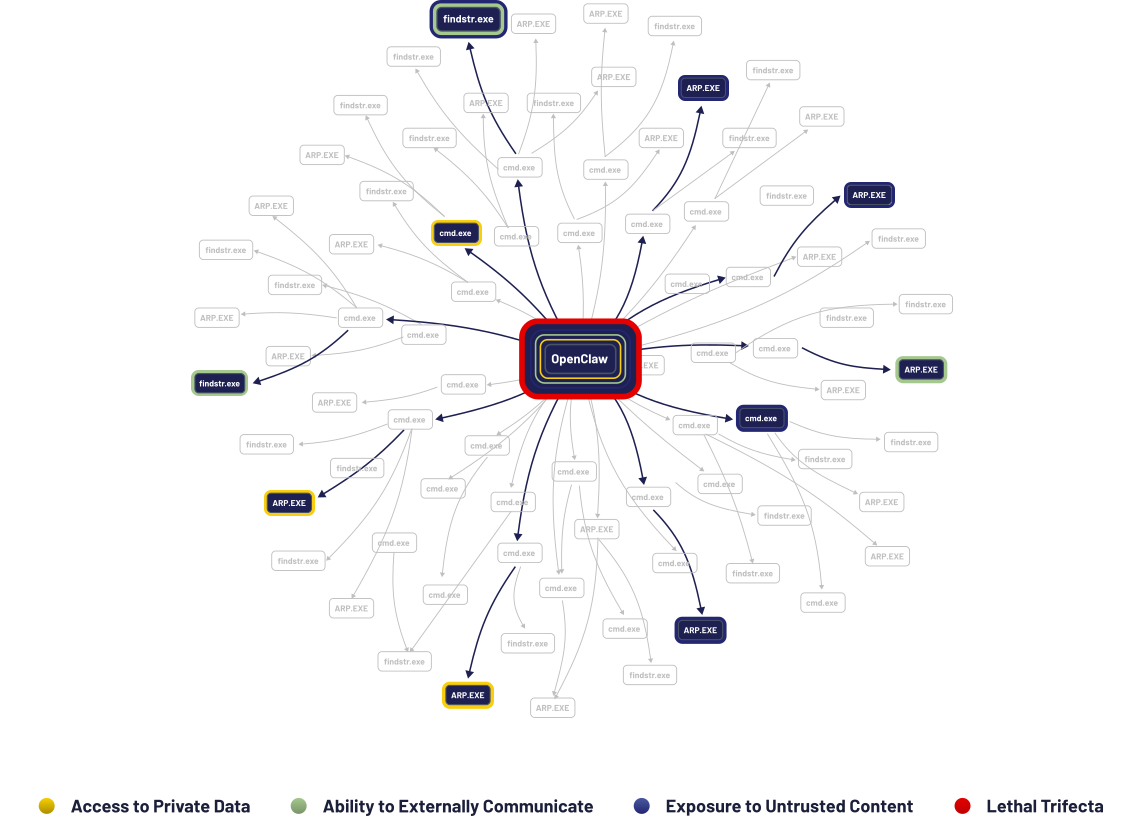
Now, the data shows how widespread that condition has become. And the numbers are worse than most leaders assume.
98% is not a typo
The Cloud Security Alliance (CSA) recently published a research note summarizing an independent assessment of 100 commercial and publicly available production AI agents. The findings should reframe how every security team thinks about AI agent security.
Only 11% of the agents assessed passed a baseline security benchmark. That means 89% failed to meet minimum security expectations, leaving organizations exposed to agents that may be capable enough to cause meaningful harm but not sufficiently defended to prevent it.
More striking still, the lethal trifecta was present in 98% of the agents evaluated. Nearly every production agent assessed had simultaneous access to private data, exposure to untrusted external content, and the ability to take outbound action. In other words, the exact conditions Willison warned about are not an edge case. They’re the architecture.
This isn’t because every product team is careless. As the CSA note explains, each capability is a feature, not a flaw. An agent that cannot read untrusted content cannot process real emails or documents. An agent that cannot take outbound action cannot complete most tasks worth automating. The trifecta is the byproduct of building agents that are actually useful. The problem is that the market has not consistently penalized that combination, so very few organizations have been forced to make the trade-off explicitly.
The most capable AI agents are the least defended
If the trifecta were confined to low-tier tools, this would be a smaller story, but it’s not. The CSA research note describes a capability-defense inversion, and it is the part of this dataset that should worry security leaders most.
The agents with the broadest capabilities tend to have the thinnest defenses. Coding agents ranked second in capability but eighth in defense, despite often holding write access to code repositories, build pipelines, and deployment systems. Computer-use agents, which can operate a full desktop the way a human can, averaged a score of zero on output guardrails. The lowest possible rating.
The research groups the worst offenders into a category it calls “Exposed Giants”: high capability paired with low defense. These agents make up 40% of the population studied but account for 60% of the aggregate risk. A minority of agents are carrying the majority of the exposure, and they are frequently the ones employees reach for first.
This mirrors a broader enterprise pattern DTEX continues to highlight. The tools that move fastest into the enterprise, often through shadow AI adoption rather than formal procurement, are frequently the same tools carrying the most risk and the least oversight. Self-serve agents that employees install on their own, bypass the compliance review that enterprise procurement would normally enforce.
Why this is an insider risk problem, not just an AI problem
It would be easy to read these numbers as a vendor problem, something for AI companies to fix in their next release. That reading misses the point.
The trifecta becomes dangerous the moment an agent inherits a human’s access and starts acting on that human’s behalf. At that point, the question changes. It’s no longer only “Is this model safe?” It becomes “Who or what just moved the data, and were they allowed to.”
That is an insider risk question. It always has been.
The supporting data backs this up. The 2026 Ponemon Cost of Insider Risks Report found that 92% of organizations say generative AI has changed how employees access and share information, yet only 18% have fully integrated AI governance into their insider risk programs. 73% worry that unauthorized AI use is creating invisible data exfiltration paths. Separate CSA research found that 86% of organizations report no visibility into AI data flows, and only 21% of executives have complete insight into what permissions their agents hold.
So the trifecta is nearly universal, the most dangerous agents are the least defended, and most organizations cannot see what their agents are doing. That isn’t a future problem. It’s the current operating environment.
The verification gap makes it worse
Here is the detail that should give every security leader pause. Many organizations believe their agents are defended when they’re not.
The CSA research found that 83% of vendor-claimed defenses lacked independent verification. Most AI agent security posture statements are self-reported rather than tested, and procurement decisions are being made on that basis. Worse, 37% of agents that scored well on audit logging performed poorly on actual harm prevention.
Logging is not protection. An agent that carefully records every step of a prompt injection attack before completing it has documented the incident, not prevented it. Conventional application security learned this lesson years ago. The AI agent space is relearning it from scratch, in production, at machine speed.
What AI agent risk means for security teams
The instinct to ban AI agents will fail, and it will push usage further into the shadows where you have even less visibility. The goal isn’t to eliminate the trifecta everywhere. The goal is to understand where all three conditions align, reduce unnecessary exposure, and know who or what act when they do.
That starts with a few honest questions. Where in your environment can an agent touch sensitive data, ingest untrusted content, and communicate externally in the same workflow? Can you see that workflow end-to-end, including prompts, tool calls, file access, and outbound movement? And when something moves, can you attribute the action to a human, an agent, another agent, or a compromised workflow?
If the answer to that last question is no, you do not have an AI problem. You have an attribution problem. And attribution is exactly where behavioral intelligence earns its place.
This is the problem DTEX AI Risk Management (AIRM) and the DTEX Agentic Defenders are designed to address. DTEX AIRM connects human behavior, AI activity, and data exposure to help teams uncover emerging risk, accelerate investigations, and enable safer AI adoption. The DTEX Agentic Defenders extend that foundation with AI-native workflows that help teams hunt, investigate, triage, and summarize complex signals across human and AI-driven activity.
Triage Guardian helps security teams evaluate and validate risk with paired analyst-and-reviewer agents and a human-in-the-loop. Threat Hunter helps teams proactively hunt for risky behavior across users, data, and AI activity rather than waiting for a single alert to fire. Together, these capabilities help security teams move from fragmented AI visibility to evidence-backed action.
The lethal trifecta is no longer a thought experiment. It’s already the condition of 98% of assessed agents. The organizations that come out ahead won’t be the ones that adopted AI slowest. They will be the ones who understood where they had delegated authority without matching it with visibility, attribution, and behavioral context, then closed the gap before someone else found it first.
See how DTEX brings behavioral context, attribution, and oversight to human and AI activity across your environment.
FAQ: The lethal trifecta of AI agents
The lethal trifecta occurs when an AI agent can access sensitive data, process untrusted content, and communicate externally within the same workflow. When these three conditions align, a malicious or hidden instruction can influence the agent, trigger access to private data, and move that data outside approved controls. The term was coined by technologist Simon Willison in June 2025.
According to an independent assessment of 100 production AI agents summarized by the Cloud Security Alliance, the lethal trifecta was present in 98% of agents evaluated. Only 11% of the agents assessed passed a baseline security benchmark, meaning the vast majority of deployed agents are both highly capable and insufficiently defended.
Exposed giants is a term from the AI Risk Quadrant Q2 2026 research describing agents with high capability and low defense. These agents make up roughly 40% of those assessed but account for about 60% of the aggregate risk. Coding agents and computer-use agents frequently fall into this category because they hold broad access while carrying minimal guardrails.
AI agents often operate with delegated access from a user, system, or workflow. When an agent can act on a person’s behalf, access sensitive data, and communicate externally, an organization may struggle to determine whether an action was taken by the employee, the agent, another agent, or a compromised workflow. That attribution challenge is a core insider risk concern, not just a model safety issue.
Organizations can reduce AI agent risk by auditing where the three trifecta conditions align, applying least privilege to users and agents, scoping tool permissions, inspecting untrusted content at ingestion, and building attribution into AI monitoring and insider risk programs. Critically, teams should distinguish between logging capability and actual harm prevention, and independently verify vendor security claims rather than accepting self-attestation.
Subscribe today to stay informed and get regular updates from DTEX