

Meet DTEX Triage Guardian: Autonomous Triage Built on Behavioral Intelligence

MIN
Validated triage for human and AI risk
Security teams are swimming in signals, and those signals can surface faster than analysts can investigate them. Alerts, telemetry, behavioral indicators, AI activity, and data movement can all point to pieces of the story. The challenge is quickly determining which pieces matter and whether the evidence is strong enough to act on.
For security, urgency is critical. Analysts often race to understand and contain risk before suspicious activity progresses into data loss, account compromise, or a broader security incident. Yet traditional triage requires them to reconstruct context manually, interpret ambiguous behavior, and decide whether activity is routine, negligent, compromised or malicious. In high-volume environments, that work can delay intervention when every moment matters.
DTEX Triage Guardian helps change that. Triage Guardian, for short, is an autonomous, multi-agent triage system that helps security teams move from alert review to validated risk. Built on DTEX behavioral intelligence, it automatically gathers evidence, analyzes user and AI agent activity, and independently reviews conclusions before evaluating risk for human review.
The result is faster, more defensible triage, where teams can spend less time piecing together what happened and more time responding to verified threats.
Not just faster triage. Validated triage.
Speed only matters if the answer is trustworthy. A triage system can summarize an alert quickly and still leave analysts with the same question they had before: can we trust this conclusion?
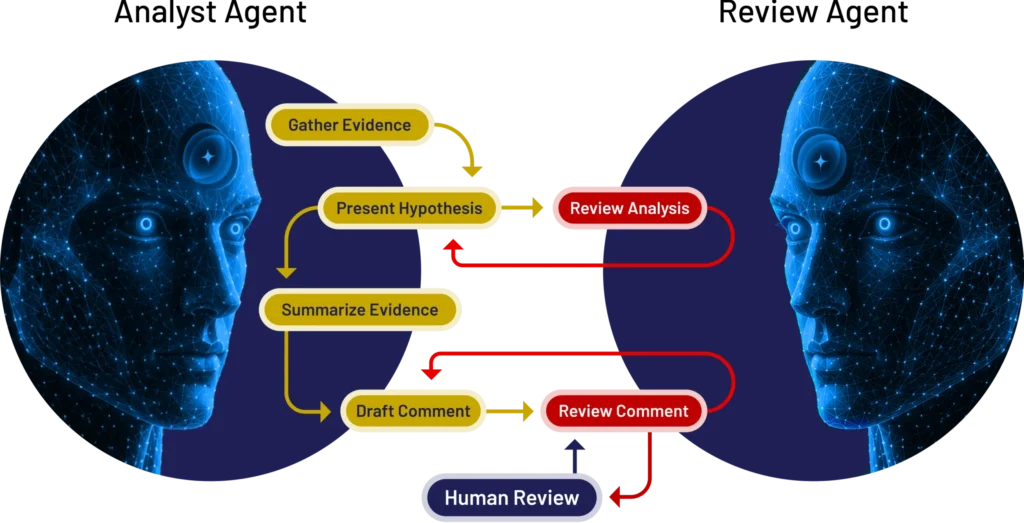
Triage Guardian uses a paired-agent model with a human in the loop. One agent acts as the Analyst, gathering evidence and developing a conclusion. A second agent acts as the Reviewer, independently checking that conclusion against defined confidence and quality thresholds. If the finding doesn’t meet the standard, the system loops back, expands the context window, and builds a stronger picture of the behavior before trying again.
Security teams don’t need another tool that turns an alert into a neat paragraph and calls it finished. They need triage that can explain what happened, why it matters, and whether the evidence supports escalation.
Triage Guardian gives analysts a narrative summary, confidence context, and a decision trail they can review. The workflow is autonomous, but the outcome is transparent. That’s what separates faster triage from validated triage.
Behavioral intelligence is the difference
What makes Triage Guardian useful isn’t AI alone. It’s the behavioral intelligence behind it.
Most security triage starts with an alert. Triage Guardian starts with context. It’s build directly on the DTEX Platform, which captures high-fidelity behavioral metadata across user activity, data movement, risk indicators, AI interactions, and historical patterns.
Triage Guardian doesn’t replace the behavioral intelligence analysts already rely on in the DTEX dashboard. It operationalizes it. The agent analyzes the same rich context surfaced through DTEX, then gathers evidence, evaluates activity patterns, and produces a validated triage summary teams can review and act on.
In insider risk, suspicious behavior rarely appears as one obvious event. A file download may be routine. A cloud upload may be normal. A PowerShell interaction may be administrative. But when those activities are evaluated together, in sequence, and against a user’s or agent’s historical patterns, the story can change.
Triage Guardian helps analysts understand that story faster. It looks before, during, and after the moment of risk to understand what changed, what connected, and what the behavior may indicate. That gives teams a clearer view of intent, not just activity.
How Triage Guardian turns dashboard signals into validated outcomes
Triage Guardian is best understood as the triage layer that helps analysts quickly make sense of the behavioral intelligence already available in the DTEX Platform.
When a signal needs review, Triage Guardian gathers the relevant evidence around the event. It analyzes user activity, AI agent activity, data movement, risk indicators, peer and historical patterns, and the surrounding timeline. Instead of asking an analyst to manually reconstruct the investigation from dashboard views, Triage Guardian assembles the context and evaluates whether the behavior points to meaningful risk.
The Analyst agent develops a hypothesis based on the evidence. The Reviewer agent then checks that conclusion against quality and confidence thresholds. If the conclusion isn’t strong enough, the workflow loops back. The agent widens that activity window, gathers more context, and refines the analysis until the outcome meets the prescribed standard or requires further human review.
This is where Triage Guardian becomes more than a productivity feature. It turns dashboard signals into reviewable, evidence-backed outcomes. Analysts still have visibility into the underlying activity, but they don’t have to start from scratch every time an alert appears.
Built for risk across humans and AI agents
The triage problem is getting harder because the definition of insider risk is expanding.
Security teams are no longer only evaluating human activity. They also need to understand AI agents that access data, interact with applications, execute tasks, and operate under or alongside human identities. These agents can move quickly, act autonomously, and create risk in ways traditional alert review wasn’t built to interpret.
This is part of the broader market shift toward guardian agents, which are emerging as oversight mechanisms for AI agents and autonomous workflows. For security teams, oversight can’t stop at whether an AI agent completed a task. Teams need to understand whether the behavior made sense, whether the access was appropriate, whether the activity changed from the norm, and whether the outcome created risk.
Triage Guardian applies the same behavioral lens to AI agents that DTEX applies to human insider risk. It helps teams monitor human and AI-driven activity with context, confidence, and a clear explanation of why a behavior may require review.
That becomes the future of AI risk management: not more disconnected alerts, but better context around how users, agents, applications, files, and data movement connect over time.
Less time investigating. More time responding.
The value of validated triage is practical. It gives analysts time back without asking them to trade away rigor.
One Australian government agency that deployed Triage Guardian estimated that it saves each analyst roughly 40 hours per month. By removing the manual effort of reconstructing context around each alert. Work that previously took 30 minutes to an hour per alert, and sometimes several hours, is now surfaced in a clear summary of what happened and why it matters.
The agency also reported 100% aaccuracy from the system to date and noted that Triage Guardian helped lower the skill barrier for Tier 1 and Tier 2 analysts. Analysts could review findings and make sound devisions without needing to be deep experts in every underlying technology.
Triage Guardian isn’t only about speed. Plenty of tools can be fast. Triage Guardian is about helping teams move faster with evidence, validation, and confidence.
When analysts can trust the context in front of them, they can spend less time chasing noise and more time responding to verified risk.
The triage layer of the DTEX Agentic Defenders
Triage Guardian is one of three DTEX Agentic Defenders, built to help security teams find, triage, and act on risk across human and AI activity.
Threat Hunter helps surface emerging risk. Triage Guardian evaluates known risk, identified by security alerts, and Risk Assistant helps summarize risk through short, pre-set investigative playbooks.
Together, they support a more complete insider risk workflow. Triage Guardian has a specific role in that system: it turns behavioral intelligence into validated outcomes, helping analysts understand which signals deserve attention and why.
As humans and AI agents work side by side, the future of triage won’t be defined by who can generate the fastest summary. It will be defined by who can produce the most defensible conclusion.
That’s what DTEX Triage Guardian was built to do.
See DTEX Triage Guardian turn behavioral intelligence into validated security triage.
Learn how one government cyber team put Triage Guardian to work in our case study on agentic triage.
FAQ: DTEX Triage Guardian
DTEX Triage Guardian is a fully autonomous, multi-agent AI system that triages security alerts related to insider risk and AI agent activity. It pairs an Analyst agent, which investigates and gathers evidence, with a Reviewer agent, which independently validates conclusions, to produce verified, defensible outcomes with confidence scoring. It is part of the DTEX Agentic Defender suite.
SOAR platforms execute predefined response playbooks and SIEMs correlate logs against detection rules. Triage Guardian instead reasons over behavioral context using high-fidelity user and entity telemetry to understand intent, not just activity. It also uses paired-agent oversight, so every conclusion the Analyst agent reaches is independently checked by a Reviewer agent before it reaches your team.
Single-agent AI tools can hallucinate, miss context, or produce confidently wrong conclusions. Multi-agent oversight is a structural safeguard. Triage Guardian’s Analyst agent investigates and proposes a conclusion, and the Reviewer agent independently challenges it against the evidence and predefined quality thresholds. Only conclusions that survive review reach your team, which delivers higher accuracy and a defensible audit trial.
Yes. As autonomous AI agents increasingly operate with privileged access, Triage Guardian can apply the same behavioral analysis to an AI agent that it applies to human insider. This addresses a major visibility gap, given that only 18% of organizations have integrated AI monitoring into their insider risk programs.
Yes. Triage Guardian is privacy-by-design. It uses DTEX’s patented pseudonymization techniques to protect user identities, has no direct internet access, and is built on Amazon Bedrock with strict security controls. It doesn’t train on customer data, and its retrieval-augmented generation architecture grounds all analysis inside DTEX Risk Intelligence without exposing customer information externally.
Subscribe today to stay informed and get regular updates from DTEX