


AI Agent Oversight
AI Agents Are Becoming Privileged Insiders
Modern AI agents can make decisions, interact with systems, and take action at machine speed. Without proper oversight, accountability becomes harder to trace, leaving organizations exposed to risks that traditional security controls were never designed to manage.
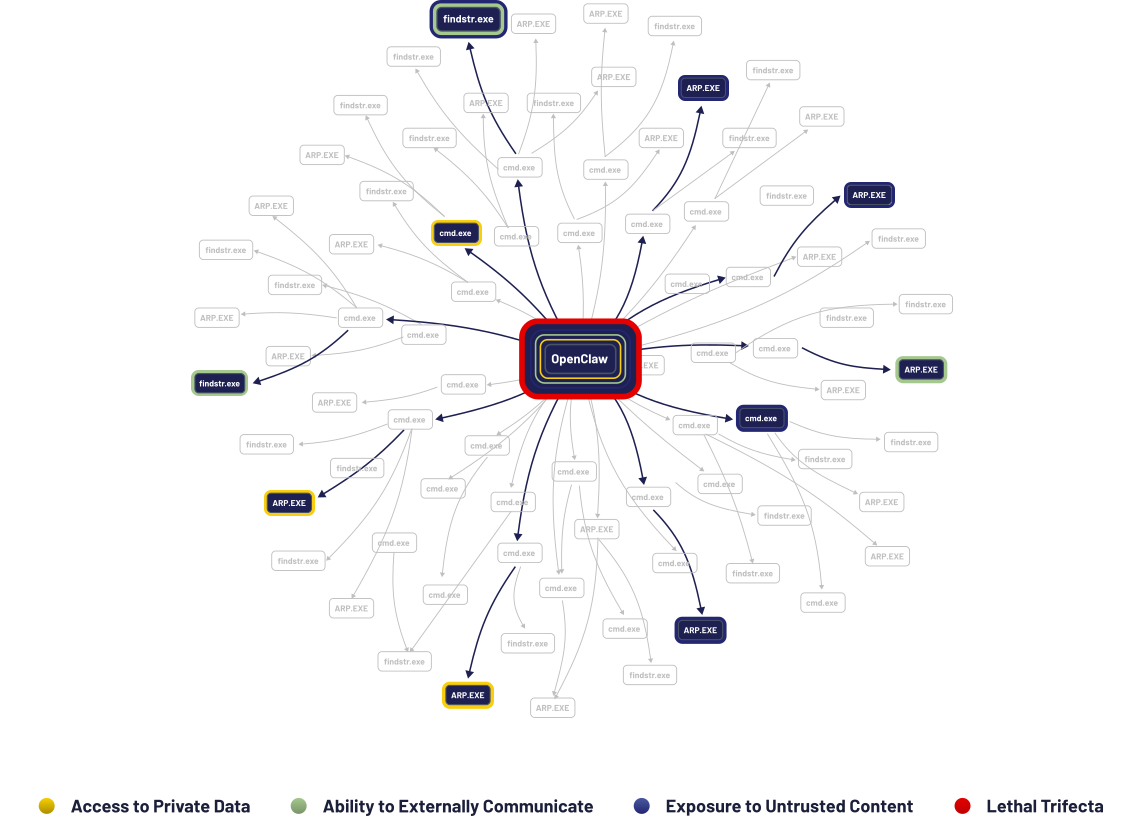
Control breaks down as AI autonomy increases
Agents inherit trusted access
Agents access systems with credentials and speed far beyond a typical employee, often deployed without security review.
Runtime decisions create blind spots
Autonomous systems dynamically decide what actions to take based on changing context.
Traditional telemetry misses intent
Logs show outcomes, but not the prompts, reasoning, or lineage behind agent actions.
Human vs. agent attribution disappears
Without process-level lineage, agent activity appears as human behavior inside the user session.
See how DTEX connects human intent to autonomous AI behavior
Watch a real-world example of how DTEX surfaces agentic activity, attributes every action to its source, and stops autonomous data movement before it leaves the enterprise.
AI agent oversight requires more than logs and policies

Dynamic AI agent discovery
Continuously inventory AI agents, copilots, and autonomous workflows operating across the enterprise, including unsanctioned or embedded agents.

Prompt + action lineage
Trace every AI agent action back to the originating prompt, reasoning chain, and human instruction that initiated it.

Behavioral AI risk scoring
Identify and prioritize risky AI agent behavior based on sensitive data access, external communications, privilege escalation, anomalous activity, and behavioral drift over time.

Computer-use application lineage
Recursively trace computer-use AI agent activity across applications, processes, and workflows to clearly distinguish human actions from autonomous agent behavior.

Real-time agent risk detection
Surface anomalous agent behavior as it happens, including unusual data access, unauthorized workflow execution, and risky action chains before sensitive data moves.

Human-in-the-loop oversight
Enable security teams to investigate, validate, and intervene when agent behavior deviates from expected workflows or crosses enterprise risk thresholds.
Capabilities traditional security and AI tools still miss
Most AI security tools focus on policy state, prompts, or API visibility. Effective AI agent oversight requires behavioral context, lineage, attribution, and real-time risk detection across autonomous workflows.
| Coverage needed for agentic AI | Traditional security & AI tools | DTEX AI Risk Management |
|---|---|---|
| Differentiate human vs. AI agent actions | Agent activity is logged under the human identity, making agent action difficult to distinguish from human behavior | Identifies processes spawned by AI agents and attributes every action to the correct human or autonomous actor |
| Prompt & action lineage | Captures isolated events without the prompts, reasoning, or decision chains behind agent actions | Builds a full lineage of agent instructions, how decisions evolved, and which human initiated the workflow |
| Computer-use application lineage | Treats agent clicks, typing, uploads, and workflow execution as normal human activity | Tracks computer-use AI agents across applications, processes, and workflows with full behavioral lineage and attribution |
| Behavioral AI risk detection | Rule-based detections and human-trained UEBA struggle to identify autonomous agent risk without generating noise | Behavioral intelligence tuned for agentic activity surfaces anomalous behavior, risky escalation patterns, and sensitive data movement in real time |
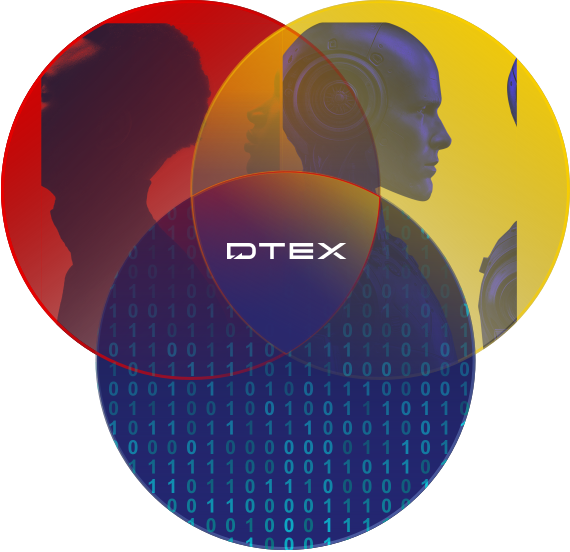
AI agent oversight requires visibility across human, data, and AI risk
AI agent risk emerges when human behavior, sensitive data, and autonomous systems intersect. DTEX AI Risk Management unifies visibility across all three to detect emerging risk, reconstruct agent activity, and apply oversight in real time. LEARN MORE
Human behavior
Data exposure
Agentic AI
FAQs about AI agent oversight
AI agent oversight is the practice of monitoring, attributing, and controlling the actions autonomous AI agents take inside an enterprise, the same way security teams monitor privileged human users. Because modern agents chain tasks across tools and data sources at machine speed, oversight requires behavioral telemetry that goes beyond logs and policy state to capture the prompts, plans, and decisions behind each action. DTEX AI Risk Management delivers that oversight through the following core capabilities: observability, prompt and action lineage, attribution and accountability, and risk detection.
AI agents operate as privileged users that compose their next action at runtime, branching across SaaS apps, APIs, and data sources faster than static rules can adapt. Traditional DLP and audit logs tell you what happened, but they strip away the prompt, plan, and human direction behind the action, leaving analysts without the “why”. DTEX captures the behavioral signal behind every agent step, so risk becomes visible as it forms rather than after sensitive data has already moved.
DTEX differentiates human and AI activity at the behavioral telemetry layer, attributing each action to the correct actor (person, process, or agent) even when an agent is operating under a user’s identity. That clean attribution is what makes accountability enforceable: analysts can hold the right party responsible instead of drowning in noise generated by agent activity that looks like a human user in conventional DLP. It’s also what enables targeted human-in-the-loop mitigation rather than blanket blocking that erases the productivity case for agentic AI.
Prompt lineage is the end-to-end record of the instructions, sub-prompts, and problem-solving steps that produced an AI agent’s action. It matters because agent actions are the output of reasoning chains, and without the reasoning, security teams can’t tell a legitimate workflow from an early-stage exfiltration path. DTEX captures prompt and action lineage so investigators can trace any agent decision back to its source, intervene before risk escalates, and apply human-in-the-loop controls grounded in real intent, not guesswork.
AI agent oversight is one of the core capabilities of DTEX AI Risk Management, the unified platform for monitoring human, AI, and agentic risk across the enterprise. Alongside AI utilization and shadow AI discovery, and operating under the AI Risk Intelligence framework, which includes the lethal trifecta, AI agent oversight gives security teams real-time visibility into how autonomous agents are operating, who is directing them, and when behavior is drifting toward risk. It’s designed to make safe agentic AI adoption possible at enterprise scale, without slowing the workflows the business depends on.
The latest agent oversight resources




Ready to bring oversight to your AI agents?
DTEX AI Risk Management helps organizations understand, prioritize, and stop the risk created by human factors, AI usage, and agentic workflows across the enterprise.