

DTEX Named a Leader in the QKS Group SPARK Matrix™ for Insider Risk Management

MIN
DTEX has been recognized as a Leader in the QKS Group SPARK Matrix™: Insider Risk Management, Q3 2026.
While analyst recognition is always rewarding, what matters most is why DTEX was positioned among the very top Leaders. This report highlights a broader shift happening across the insider risk market. Organizations are no longer looking for isolated monitoring tools. They need platforms that combine detection, privacy, investigation, automation, and risk mitigation into a single operational workflow. Mitigating insider risk just isn’t effective without this combination.
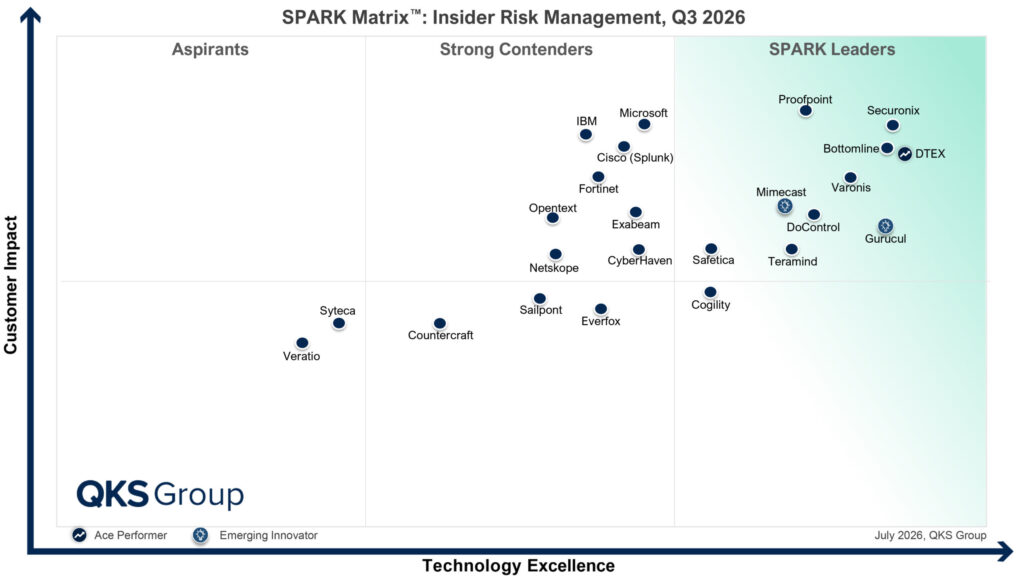
In its key findings, QKS notes that modern insider risk programs increasingly require organizations to unify behavioral signals, identify context, endpoint activity, cloud usage, and workflow automation to create a complete risk narrative rather than a collection of disconnected alerts. That trend aligns closely with the approach DTEX has taken from the beginning.
Insider risk has moved beyond monitoring
One of the most important observations in the report is that detection alone is no longer enough. According to QKS, buyers increasingly prioritize platforms that bridge the gap between identifying risk and enabling response through integrated workflows, case management, automation, and remediation. This has been a defining principle of the DTEX platform.
Rather than producing large volumes of security telemetry for analysts to sort through, DTEX focuses on behavioral intelligence, risk prioritization, and investigative context. The goal is to help security, insider risk, HR, legal, and compliance teams understand not just what happened, but why it happened and what action should be taken next.
As insider threats become more complex and increasingly intersect with AI adoption, SaaS sprawl, data protection, and workforce risk, organizations need solutions that support the entire risk lifecycle.
Behavioral intelligence continues to be a differentiator
QKS also highlights an important market challenge: not all behavioral analytics are created equal. The report notes that many vendors claim AI-driven capabilities, but the depth of behavioral modeling and risk correlation varies significantly across the market. This is an area where DTEX continues to differentiate.
The foundation of the platform is behavioral intelligence. Rather than relying solely on static rules or policy violations, DTEX analyzes user activity patterns, context, and risk indicators to surface behaviors that may indicate careless, compromised, malicious, or high-risk activity.
This behavioral approach helps security teams identify emerging risks earlier, reduce false positives, and prioritize investigations based on intent and context rather than simple alert volume.
As organizations struggle with alert fatigue and increasingly limited analyst resources, behavioral intelligence becomes critical for separating meaningful risk from background noise.
Privacy-first architecture matters more than ever
Another major theme throughout the report is the growing importance of privacy engineering. QKS identifies privacy controls like pseudonymization, and auditable investigations as foundational requirements for modern insider risk programs.
This reflects what many global organizations already know: insider risk programs succeed only when they balance security outcomes with employee privacy requirements.
DTEX has long emphasized privacy-by-design principles, enabling organizations to investigate risk while supporting regional privacy regulations and internal governance policies. Rather than treating privacy as an afterthought, DTEX incorporates privacy protections into the operational design of the platform.
As insider risk programs continue expanding globally, privacy engineering is increasingly becoming a competitive requirement rather than a differentiator.
A unified view of human risk
The report also notes that the market is evolving toward platforms capable of synthesizing identity, content, behavior, endpoint telemetry, SaaS activity, and contextual information into a single risk narrative. This convergence reflects a broader industry reality.
Human risk can no longer be understood through a single data source.
Organizations need visibility into employee behavior across endpoints, browsers, cloud applications, collaboration platforms, and increasingly, AI applications and agents. Security teams must understand how sensitive data moves, how users interact with that data, and whether activity represents legitimate business behavior or elevated risk.
DTEX’s approach to behavioral intelligence helps organizations connect these signals into a more complete picture of risk, allowing investigators to make decisions based on context rather than isolated events.
From detection to risk reduction
Perhaps the most significant finding in the report is QKS’s observation that the market is beginning to move beyond reactive monitoring toward proactive risk reduction. The report identifies behavior modification, contextual guidance, and targeted awareness as emerging areas that are likely to shape the future of insider risk management. This is especially relevant as organizations grapple with AI-enabled workflows, increasing insider threats, and expanding regulatory pressures. Simply detecting risky behavior after the fact is no longer sufficient.
Security leaders increasingly want solutions that help influence behavior, reduce risk before incidents occur, and operationalize human risk management as a continuous process.
That shift aligns closely with DTEX’s long-term vision of transforming insider risk from a post-incident investigation function into a proactive discipline focused on understanding and reducing human risk.
Validation of a changing market
The QKS SPARK Matrix does more than rank vendors. It captures where the insider risk market is heading. The report highlights several defining trends, including deeper behavioral analytics, stronger privacy engineering, integrated workflows, AI-powered risk intelligence, and a growing focus on proactive risk mitigation. These are the same trends driving investment and innovation across the DTEX platform.
Being recognized as a Leader by QKS is exciting because it reflects not only the capabilities DTEX delivers today, but also the direction the market itself is moving.
As insider risk management continues evolving into a broader human risk management discipline, organizations need platforms capable of delivering behavioral intelligence, privacy-first investigations, operational workflows, and actionable risk insights at scale.
According to QKS Group, those capabilities are increasingly defining the leaders in the market. We’re proud to see DTEX recognized among them.
FAQs
Behavioral intelligence helps organizations identify insider threats earlier by understanding how users normally work and detecting meaningful deviations from those patterns. Rather than relying solely on static rules, policy violations, or alert thresholds, behavioral intelligence correlates user activity, risk indicators, context, and intent to surface potentially harmful behavior. This approach helps security teams reduce false positives, prioritize investigations, and focus on the highest-risk activities. As insider threats become more complex and analyst resources remain limited, behavioral intelligence enables organizations to separate genuine risk from normal business activity.
Organizations can balance insider risk management and employee privacy by adopting privacy-by-design technologies that include controls such as pseudonymization, role-based access, and auditable investigations. Privacy-first insider risk programs allow security teams to investigate suspicious behavior while protecting employee identities until a legitimate business justification exists. This approach helps organizations meet regional privacy regulations, maintain workforce trust, and support governance requirements without sacrificing security visibility. Privacy engineering is increasingly recognized as a foundational requirement for successful insider risk programs.
Leading insider risk management platforms combine behavioral analytics, privacy controls, endpoint visibility, identity context, investigation workflows, and proactive risk reduction into a unified platform. Industry analysts increasingly note that organizations need solutions capable of connecting behavioral signals, endpoint activity, cloud usage, SaaS interactions, and contextual information into a single risk narrative. The most advanced platforms help organizations move beyond detection toward proactive risk reduction through contextual guidance, workflow automation, and behavior-focused risk mitigation. This shift reflects the market’s movement from reactive monitoring to broader human risk management.
Topics
Subscribe today to stay informed and get regular updates from DTEX