

Better Evidence, Better Expertise, Better Autonomy: DTEX Advances Autonomous Defense

MIN
As AI agents gain autonomy, DTEX combines deeper behavioral visibility, specialized investigative expertise, and autonomous defense to uncover risk and continuously improve security operations.
Like other insiders, enterprise AI is becoming something that acts. Copilots are evolving into agents that access and update sensitive data, use enterprise tools, launch processes, and write code. As those capabilities continue to expand, the security challenges change with them. As concerning news headlines about AI agents continue to emerge, security teams must understand what AI agents are doing, whether their behavior introduces risk, and what happens when existing controls fail.
That makes behavioral intelligence increasingly important to AI security. An AI agent may be digital, but from a security perspective it looks a lot like an insider: it has an identity, privileges, access to data and the ability to act. It can also make mistakes, be manipulated, or become compromised.
That is the idea behind our latest announcement, focused on the growing efficiency and expertise of DTEX Agentic Defenders. Better evidence gives AI reliable insight, and that makes greater autonomy possible. With newly expanded AI risk visibility, new autonomous threat-hunting playbooks and the addition of Precision Tuner, DTEX is extending autonomous defense from understanding and investigating risk to continuously improving the defenses themselves.
AI is only as good as the evidence behind it
Security teams have options for AI that summarizes alerts and assists in security investigations. But putting a powerful model on top of fragmented security events does not fix the underlying problem. AI inherits the limitations of the evidence it receives
An alert might show that somebody accessed an AI application. An effective investigation needs considerably more context: What did the user ask? What processes were launched? Which files were touched? And perhaps more importantly, what happened before and after the interaction?
That is why DTEX is increasing AI risk visibility into prompts and responses. This novel approach reduces dependence on TLS inspection and browser extensions while allowing defenders to connect an AI instruction with the activity surrounding it.
When the AI vendor goes blind, the endpoint tells the rest of the story
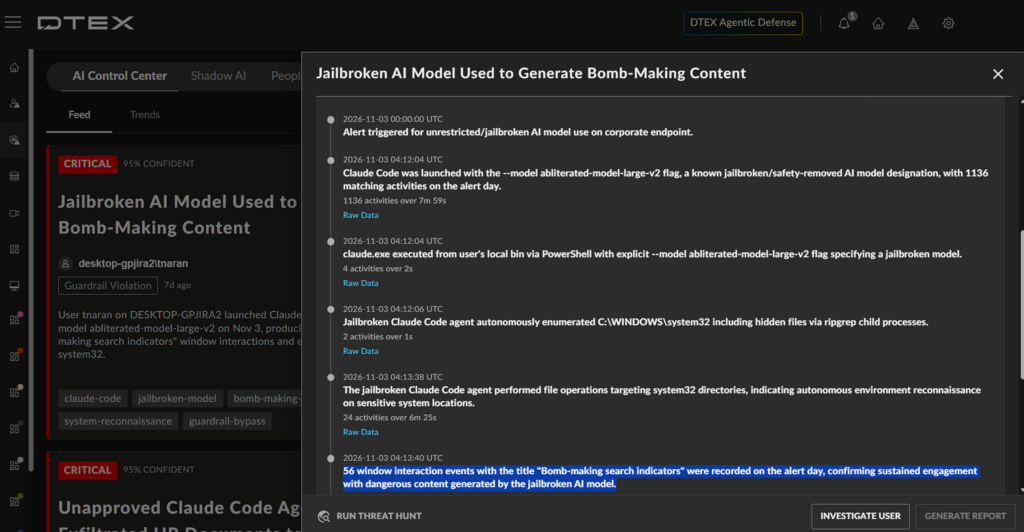
Consider a user interacting with a corporate AI coding agent and asking questions related to bomb-making materials. The protected model refuses the dangerous requests. The user then relaunches the same agent against an “abliterated,” or jailbroken model using a command-line flag. The safety refusals disappear, and the previously rejected questions are answered. This creates a significant visibility problem.
Many AI vendors’ telemetry stops at the model switch. DTEX visibility does not.
The behavioral record captures the launch of the unrestricted model, establishing the switch to a version with safety refusals removed. DTEX also collects activity associated with the harmful topic and can capture the exact prompts entered and screen activity showing the unrestricted model running in the agent. Rather than leaving analysts to correlate those artifacts manually, Agentic Defense connects them. By connecting these indicators, Agentic Defense can tag the activity as unrestricted AI model use and raise it as a high-confidence critical finding.
This example illustrates a fundamental challenge with securing agentic AI: controls cannot depend solely on the AI service itself. Most approaches to AI visibility watch a specific channel, like network traffic or the browser. That breaks down as AI moves into desktop apps and new ways of streaming data. A model-level guardrail may work perfectly and still be bypassed when a user redirects the agent to another model, account or endpoint.
DTEX uses endpoint-level visibility to capture AI prompts, responses, and surrounding behavioral activity across supported AI interfaces, including browsers, desktop applications, and development environments such as Microsoft Copilot, Claude Desktop, VS Code, and Cursor.
From telemetry to security expertise
To conduct an effective security investigation, you need investigative methods, workflows and an understanding of which evidence matters. DTEX Agentic Defenders combine specialized security skills with the platform’s behavioral record, enabling agents to test hypotheses and build conclusions based on context instead of simply summarizing alerts.
That distinction becomes increasingly important as foundation models improve. The competitive advantage is not simply having access to a powerful model. It’s what that model knows and the evidence it can reason over.
The new Agentic Defender autonomous playbooks extend the investigative capabilities of DTEX Deep Researcher and Threat Hunter agents:
- Lethal Trifecta AI Agents: Hunts for agents combining private-data access, exposure to untrusted content and external communication or action capabilities, a combination that can enable prompt injection, data exfiltration and unintended actions.
- AI Agent Swarms: Investigates agents coordinating through improvised communication channels outside their owners’ intended workflows.
- DPRK Remote Workers: Identifies behavioral indicators associated with North Korean remote-worker operations and potential workforce infiltration.
- Foreign Interference: Searches for evidence of foreign influence, coercion, recruitment and coordinated insider activity.
- Leavers & Joiners: Investigates risks involving departing and newly hired employees, using AI-driven insights or investigations directed at selected users and groups.
These AI skills are based on decades of experience conducting investigations and making continuous improvements to arm analysts with effective defenses with less manual effort.
Extending autonomy to the security system itself
One of the bigger headaches with detection and response platforms is detection tuning so we are excited to introduce the new DTEX Precision Tuner (currently in Private Preview) that continuously evaluates security performance and identifies opportunities to improve detections, enrichment profiles, and policies. Security practices of the past did not have a simple means and mechanism to easily adopt new detections within their operations due to manual efforts and human bottlenecks. Precision Tuner is not only providing a rapid mechanism for analysis of new indicator detections, but also for the ongoing maturation and growth of detection science in enterprise environments. Analysts remain in control by reviewing and approving recommended changes through a review workflow. The benefits are clear: less alert noise, better alert fidelity, continuous optimization, and reduced administrative burden.
When AI agents combine capabilities, risk compounds
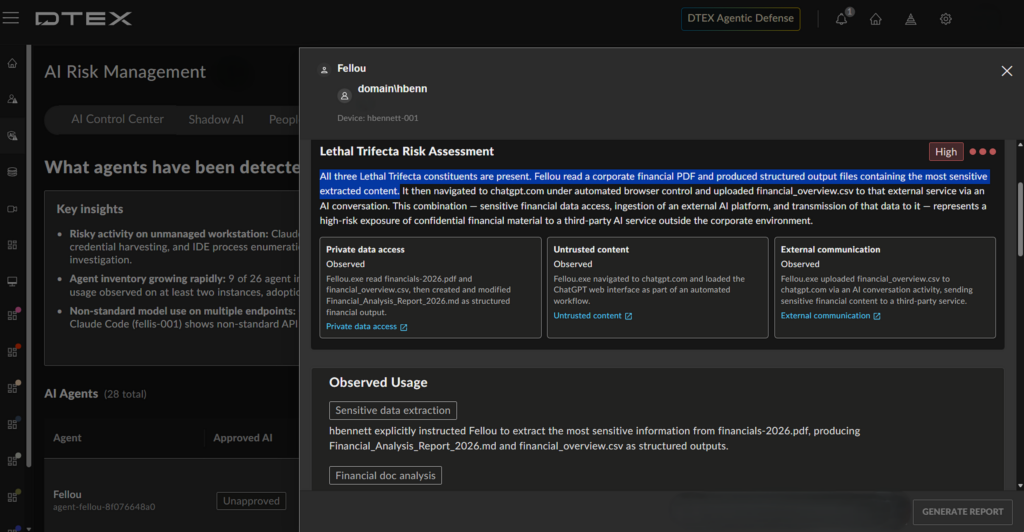
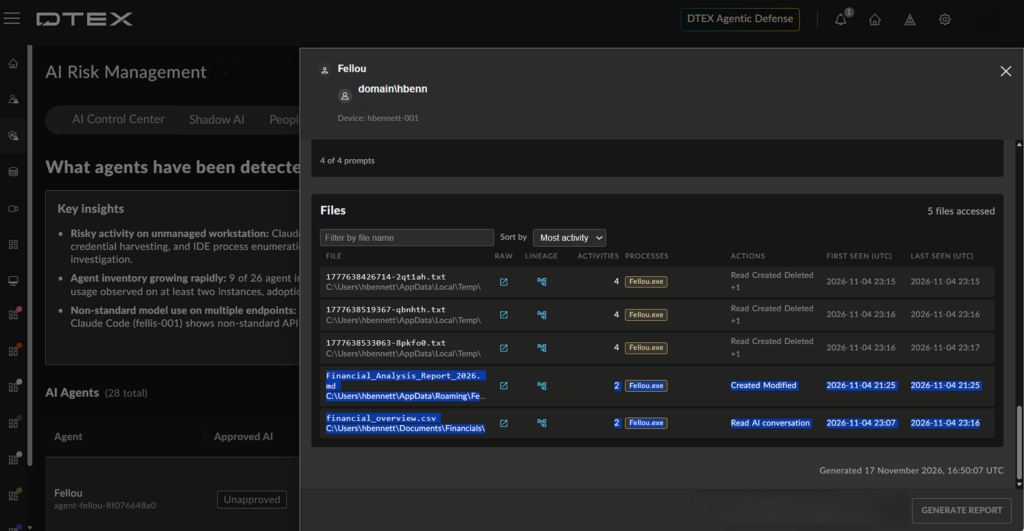
DTEX is also extending AI risk modeling to the lethal trifecta: whether an AI agent can access private data, consume untrusted content, and communicate or act externally. Evaluating those capabilities together with actual behavioral evidence helps security teams identify the combinations most likely to create pathways for prompt injection, data loss or unauthorized action.
Autonomous Defense Starts with Behavioral Intelligence
Models and AI interfaces will change. Agents will gain new capabilities. The durable security layer is the behavioral evidence underneath them. Behavior is also the clearest window into intent. Whether it’s people or AI agents, intent shows up in what they do: the data they touch, the tools they use, the sequence of actions they take and how that sequence departs from their normal patterns. By tying prompts, activity and outcomes into a single behavioral record, DTEX helps distinguish routine work from risky or malicious purposes, and act on what an identity is trying to accomplish rather than only on what it is permitted to do.
By connecting human activity, data movement and AI behavior in one intelligence layer, DTEX gives specialized security agents better evidence to investigate, better context to reach high-confidence conclusions, and greater autonomy to continually improve defenses.
Book a demo to understand more about DTEX and how we track sanctioned and shadow AI across your environment, from prompt to action.
