

DTEX vs. Proofpoint
Gain Complete User Context, Not Just Alerts
Through the industry’s most advanced behavioral intelligence, see how DTEX delivers complete activity visibility and insider risk investigation capabilities beyond traditional insider threat and DLP approaches.
Why do organizations choose DTEX over Proofpoint?
Organizations choose DTEX when they understand that deeper visibility into user behavior, workforce activity, insider risk, and AI-driven data exposure changes the game from reactive to true risk adaptive security. DTEX combines user activity monitoring, behavioral analytics, and AI risk management to provide context that traditional insider threat and DLP approaches often miss.
| Capability | DTEX | Proofpoint |
|---|---|---|
| Complete user audit trail | Yes | Limited |
| Screenshot capture | Yes | Limited |
| Behavioral intelligence | Yes | Partial |
| AI risk monitoring | Yes | Emerging |
| Insider investigations | Yes | Yes |
| Root cause context | Yes | Partial |
Key Differentiators: Why teams choose DTEX

Complete activity visibility
Understand what users actually do, before, during, and after an event, not just what systems log.

Behavioral intelligence
Identify intent, risk, and anomalies before incidents escalate, critical to taking appropriate action.

Evidence-backed investigations
Reduce time spent reconstructing insider events, with deeper context and explainable audit trail.

AI risk management
Monitor employee interactions with AI tools and copilots, differentiate between humans and AI, and identify when AI agents begin to act in risky ways.
Independent Analysts Choose DTEX
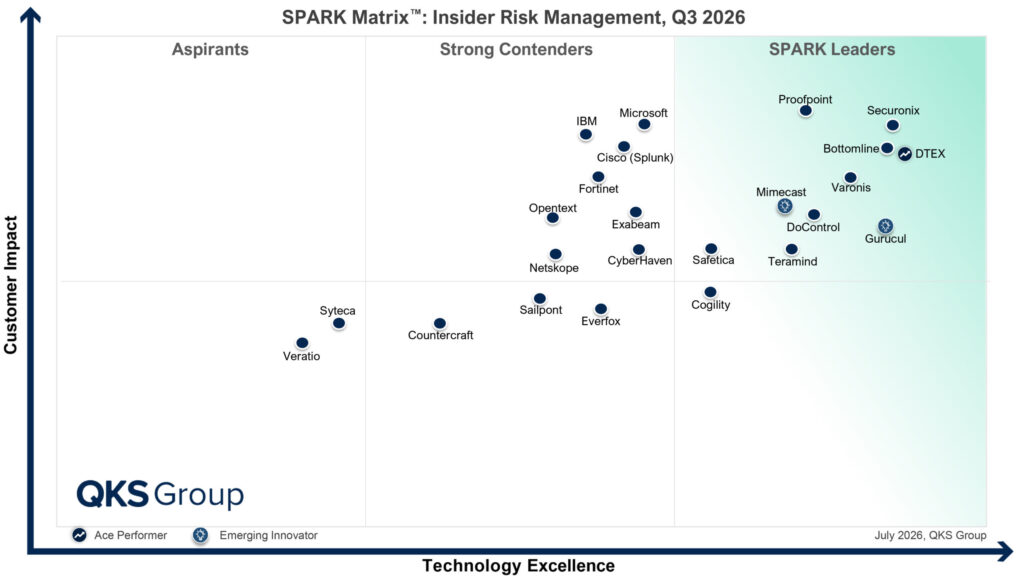
Detection alone is no longer enough. QKS notes that modern insider risk programs increasingly require organizations to unify behavioral signals, identity context, endpoint activity, cloud usage, and workflow automation to create a complete risk narrative rather than a collection of disconnected alerts.
Moving from Proofpoint to DTEX
Moving to the DTEX Platform is easy.

Deploys in minutes
Lightweight forwarders collect 3-5MB of data per user per day, create no network impact, and do not harm productivity.

Visibility in 24 hours
Realize enterprise-wide visibility, investigative audit, and protection capabilities within the first 24 hours.

Reporting in the first week
Get internal risk benchmarks, executive overviews, and actionable recommendations in the first week.

Forensics in days
Identify outlier behaviors that may be malicious, negligent, or compromised within 10 days of deployment.
What buyers evaluating Proofpoint ask
DTEX continuously analyzes behavioral metadata across the workforce to establish behavioral context and identify emerging risk. Proofpoint ITM combines endpoint DLP with user activity monitoring and supports deeper monitoring for higher-risk users. DTEX is designed to understand how risk develops over time, giving investigations behavioral context that exists before an alert or incident occurs.
Yes. Organizations evaluating Proofpoint for insider risk management can use DTEX to identify emerging insider risk, investigate user and data activity, and protect sensitive information. DTEX differentiates through continuous behavioral intelligence designed to establish context across the workforce before a user is identified as high risk.
DTEX uses patented pseudonymization to mask employee identities by default while preserving behavioral metadata for analysis. Authorized teams can reveal identity when an investigation warrants it. This allows organizations to establish broad behavioral visibility without relying on pervasive screen capture or exposing employee identities unnecessarily.
Yes. DTEX AI Risk Management discovers sanctioned and shadow AI across browser and non-browser tools, inspects prompt activity, and connects AI usage with behavioral context to identify emerging risk across the human + AI workforce.
Yes. The DTEX Platform is FedRAMP certified at the Moderate level, and DTEX was the first FedRAMP-accredited UAM solution.
User activity monitoring records what users do. Behavioral intelligence analyzes activity over time to understand what is normal, identify meaningful changes, and determine when behavior may indicate emerging risk. DTEX continuously analyzes behavioral metadata across the workforce so security teams have context before an investigation begins.
No. DTEX uses behavioral metadata to identify and assess risk without requiring continuous screen recording. Focused observation can be used when warranted, allowing organizations to investigate higher-risk activity while maintaining privacy for the broader workforce.
Yes. DTEX continuously analyzes behavioral activity and changes in user risk rather than relying only on policy violations or DLP alerts. This behavioral context can surface emerging risk before sensitive data is moved or a predefined policy is triggered.
Proofpoint AI agents are designed to automate investigation and alert triage by correlating security signals across the platform. DTEX Agentic Defenders focus on analyzing user activity, intent, workforce behavior, and AI interactions to help security teams identify, investigate, and respond to insider and AI-related risks. The comparison boils down to investigation automation vs behavioral intent determination. DTEX Triage Guardian, Threat Hunter, Risk Assistant, and Deep Research Agent apply behavioral context from native metadata collection to identify, investigate, and respond to risk. With additional defenders in development, DTEX continues to expand agentic capabilities across the insider risk lifecycle.
Put your Proofpoint evaluation through a reality check
Tell us what you’re evaluating Proofpoint for. We’ll use those priorities to show how DTEX investigates risk and responds as behavior changes.
